 Product News
A 10mm piezoelectric ceramic (piezo) high-frequency driver, inside a pair of US$99 in-ear monitors — if I told you that a decade ago in the budget IEM world, “piezo” was basically synonymous with “piercing treble,” would you be a little curious about KBEAR’s decision here?

KBEAR’s newest IEM, the Kalideer Apex-P6, is a 1DD+1BA+1Piezo triple-driver hybrid — a 10mm beryllium-plated dynamic driver handles the bass, a 30095 balanced armature covers the mids, and a 10mm piezoelectric ceramic driver takes care of the treble. It runs at 32Ω impedance and 102dB sensitivity — no trouble driving it straight from a phone. The shells are 3D-printed resin, with 0.78mm 2-pin detachable connectors. The stock cable is 5N silver-plated OFC terminated in a 3.5mm gold-plated plug. Two color options: red-blue and orange-blue. Priced at US$99, with an additional 20% off during the pre-order period, available through KeepHiFi.
But the core of this whole thing isn’t how many drivers it packs — it’s that 10mm piezo.
Piezoelectric ceramics behave quite differently from traditional balanced armatures: they rely on voltage to drive a ceramic diaphragm into vibration, yielding extremely fast transient response and treble extension that can reach beyond 40kHz — but at the same time, if the crossover point is poorly chosen or the driver itself isn’t up to par, a piezo can sound hard, sharp, and aggressively “digital.” It’s a high-reward, high-risk engineering choice.
In recent years, a handful of brands have started revisiting piezo’s potential. But what Kalideer brings this time is a 10mm large-format piezo — with significantly more diaphragm surface area than the typical micro-piezo tweeters, it theoretically delivers fuller treble body and lower distortion. The question is: can they tune it smooth?
Over on Head-Fi, users analyzing the frequency response graph note that the midrange shows no obvious recession and the treble peaks exhibit a gradual roll-off, speculating that it “won’t be fatiguing, though it might be slightly short on air.” That description aligns with a conservatively tuned piezo implementation — rather than pushing it to the limit to manufacture false detail, they’ve opted to play it safe and preserve listenability. If that holds true, it’s a pragmatic engineering trade-off.

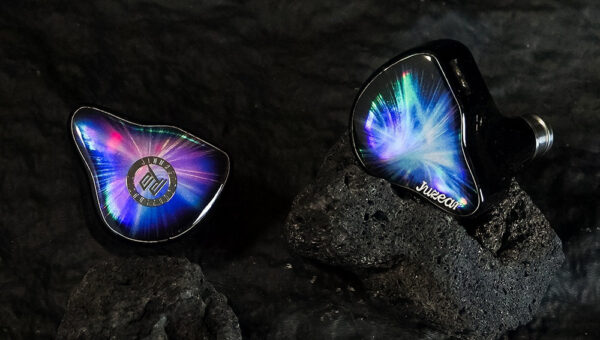
As for the design: the Kalideer’s faceplates feature a red, blue, and gold marble texture. KBEAR says the inspiration comes from the “Nine-Colored Deer” of the Dunhuang murals — this part is pure marketing storytelling, entirely unrelated to acoustics, but at least it gives the IEM some visual identity among a sea of black shells.
There’s no shortage of options at the US$99 price point right now, but using a dedicated large-format piezo for treble instead of the more common BA/electrostat hybrid approach is a path worth paying attention to — especially given KBEAR’s shipping volume and tuning experience in the budget market.
📋 Technical Specifications
| Driver Configuration | 10mm Beryllium-Plated Dynamic Driver + 30095 Balanced Armature + 10mm Piezoelectric Ceramic |
| Impedance | 32Ω |
| Sensitivity | 102dB |
| Frequency Response | 20Hz – 20kHz (acoustic extension to 40kHz+) |
| Shell | 3D-Printed Resin |
| Connector | 0.78mm 2-pin |
| Cable | 5N Silver-Plated OFC, 1.25m, 3.5mm Gold-Plated Plug |
| Colors | Red-Blue / Orange-Blue |
| Price | US$99 (~HK$775), 20% off during pre-order |
| Availability | KeepHiFi official site, pre-order available |

The Kalideer’s success won’t hinge on how many drivers it has — it’ll come down to whether that 10mm piezo has been tuned to sound natural and easy on the ears. We’ll need to hear the final unit for a definitive answer, but the direction is at least an interesting one.
📌 Sources: Head-Fi (KeepHiFi) · KeepHiFi product page