 Product News
MEMS in IEMs isn’t new. Soranik’s been at it for years, USound holds 500+ patents — the tech itself is mature. But there’s one detail the industry doesn’t talk about much: MEMS is, at its core, a semiconductor device. It uses the piezoelectric effect to produce sound, and it needs a higher driving voltage than your typical dynamic driver or balanced armature. Not a little higher — a fair bit higher.
Here’s a concrete example: USound makes a chip called the Tarvos 1.0. Its entire reason for existing is voltage step-up. In other words, to use MEMS, you normally need an external amp in the chain. Soranik’s MEMS-2 and MEMS-3 both work this way — they don’t just fire up when you plug them into your phone.
So how did KIWI Ears solve it with the Halcyon? They put the step-up circuit inside the shell. US$259, 1DD + 1 MEMS + 3 BA — and it runs straight off a 4.4mm balanced output. No external amp, no special source. Honestly, the integration challenge here is on a completely different level from adding an extra BA or swapping in a nicer DAC chip.
Binary Acoustics is walking the same road with their EP321 (US$309, also a MEMS tribrid) — packing a miniature step-up transformer inside the shell, which they call an “energizer.” Two brands, two approaches, one problem: how do you make MEMS plug-and-play within a standard IEM form factor? That’s the real threshold for MEMS in consumer IEMs — not just “driver count +1.”
Inside the Halcyon, the MEMS driver has a focused role: upper treble. USound’s spec sheet spells it out — near-zero phase distortion, ultra-fast transient response. To be fair, this isn’t marketing fluff. It’s the physics of piezoelectric silicon. Moving mass is near zero, response time is in microseconds — phase distortion approaching zero is physically plausible.
But here’s the question: the upper treble range is something a well-executed BA or piezo tweeter can already handle. The MEMS value proposition was never about “can it do it?” — it’s about “how well does it do it?” Can it deliver a level of detail retrieval and phase coherence above 8kHz that BA/piezo simply can’t match?
Marcus over at Headfonics gave a pretty honest take after his time with them: upper treble is “airy and detailed” — the MEMS delivers. But the lower treble, that 5–8kHz region, is “slightly dark.” So the overall treble presentation isn’t the stereotypical “MEMS = hyper-resolution” — it’s a curated top-end with actual character. The ultra-highs shine, but the lower treble is deliberately dialled back. That’s interesting. It suggests the tuning wasn’t a case of “let the MEMS do its thing” — someone sat down and thought about the overall spectral balance.
Tuning-wise, the Halcyon goes for a textbook neutral-with-bass-shelf approach. 8dB sub-bass boost, a 200Hz cut to keep the lower mids clean, and 3kHz pinna gain compensation. If you’ve spent any time looking at IEC diffuse-field targets, this curve will look familiar. Headfonics describes it as bassy mild L-shaped: sub-bass has weight but stays controlled — no bleed into the upper bass or lower mids. The midrange is nearly flat, no coloration — built for long sessions without fatigue. If you’re a bass-head, the quantity probably won’t satisfy. But if you want a reference-ish tribrid for daily use, this tuning makes sense.
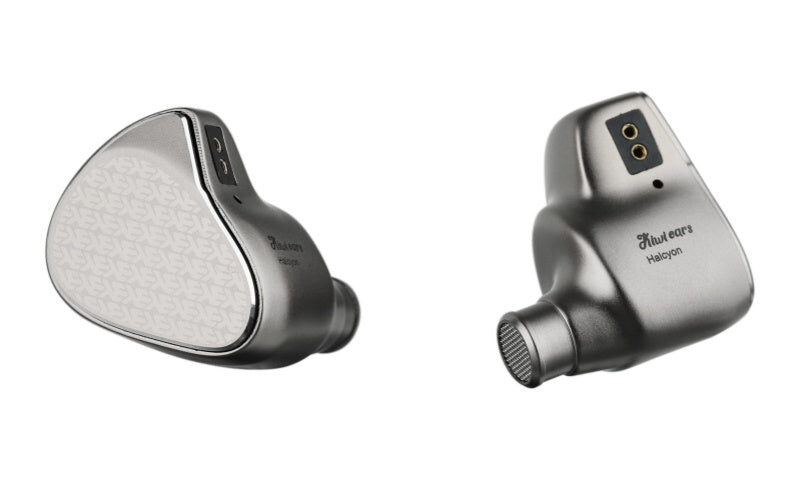
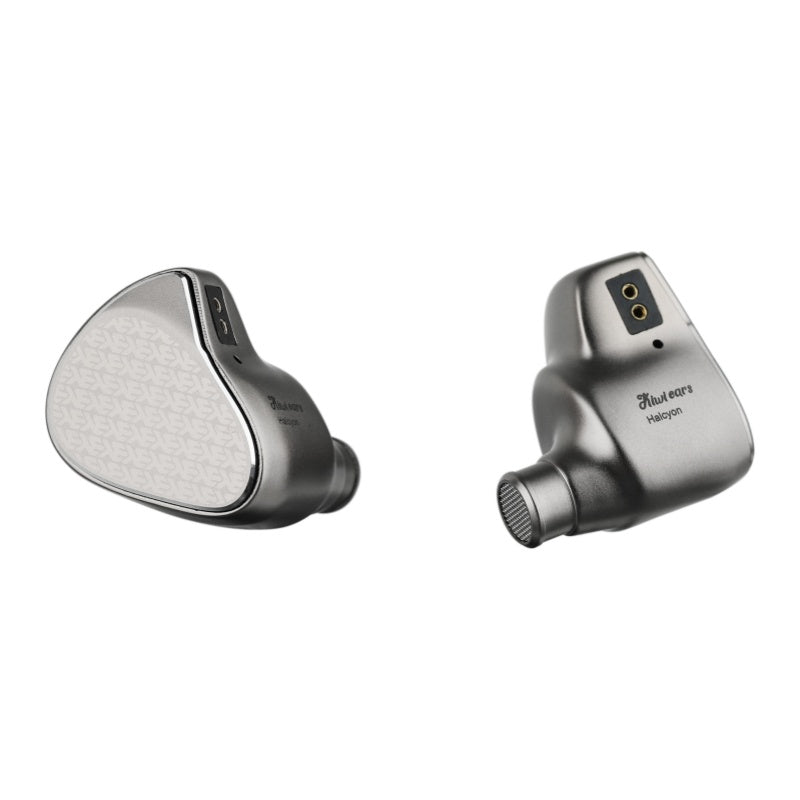
Build-wise: CNC aluminium shell, anodized finish, gunmetal grey with a geometric faceplate. I’ve got to say, I like this design language. No overdoing it, no cheap branding, no unnecessary visual noise. 5.8g per side — wearing these for hours shouldn’t be an issue. The stock cable is 4N single-crystal copper with a modular plug system (3.5mm SE + 4.4mm BAL). The official product page also mentions an optional USB-C DSP cable for app-based EQ, and it even supports a boom mic cable for gaming. KIWI Ears clearly wants the Halcyon to be a do-it-all daily driver — not just a specialist tool parked on your desk for “critical listening.”
| Specification | KIWI Ears Halcyon |
|---|---|
| Driver Configuration | 1DD (10mm) + 1 MEMS + 3 BA (2× DEK custom + 1× WBFK custom) |
| Frequency Response | 10Hz – 42kHz |
| Sensitivity | 109dB (@1kHz/mW) |
| Impedance | 29Ω |
| Distortion | <1% (@1kHz) |
| Channel Imbalance | <1.5dB |
| Connector | 0.78mm 2-Pin detachable |
| Cable | 4N single-crystal copper, modular plugs (3.5mm SE + 4.4mm BAL) |
| Weight | ~5.8g (per side) |
| Price | US$259 (Kickstarter Early Bird from US$199) |
| Availability | Pre-order; Kickstarter backers ship first, general orders estimated late June |
At US$259, the tribrid market is a bloodbath. Truthear, Simgot, 7Hz — all have sub-US$200 hybrid offerings, all backed by hundreds of reviews. The Halcyon’s differentiation is narrow, but sharp: MEMS. Not an extra BA, not another tuning mode — a fundamentally different transducer technology.
The real question — and this is the one that matters — is whether that differentiation translates into something you can actually hear. The MEMS spec advantage is measurable. But is the phase coherence improvement in the upper treble actually discernible in real-world listening? That one needs a Hong Kong demo to answer. Haven’t heard it — not going to pretend otherwise.
One thing I’m fairly sure of, though: every time someone solves the voltage problem and makes MEMS plug-and-play in an IEM, this technology takes one step closer to the mainstream. That’s what KIWI Ears has done here. Whether the step was a graceful one — that’s for an actual listen to decide.
🔗 More Info: KIWI Ears Official Product Page · USound Press Release · Headfonics Review