 Product News
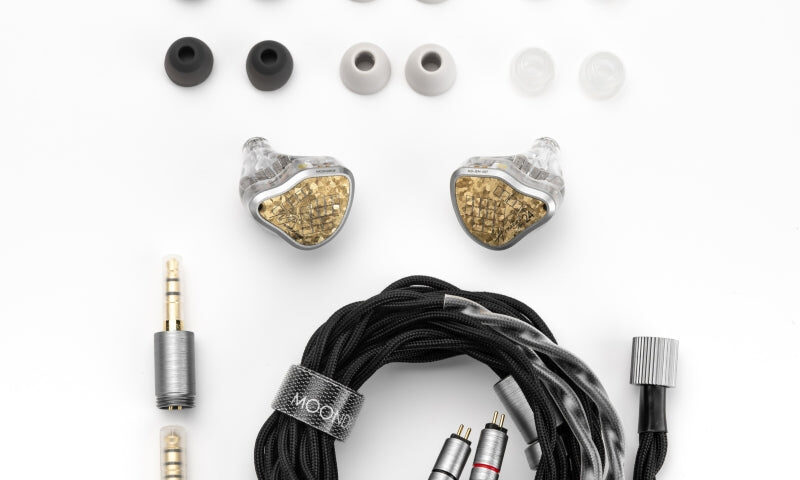
Moondrop has released an IEM packing 24 balanced armature drivers per side, called the Armature Art 24. The shell is transparent medical-grade resin, with all internal acoustic channels produced by HeyGears 3D printing — pick it up and you can feel the precision, the texture is genuinely there. But the faceplate… honestly, it made me stop for a few seconds.
The faceplate is ferroalloy with a nitriding treatment, producing an “ice flower” crystalline pattern across the surface — this bit is actually lovely, with the light catching it at different depths. The black squares on top are not random decoration — if you look closely, each square maps to the actual position of a BA driver inside. This approach of directly mapping internal layout onto the external surface is, from a product consistency standpoint, admirable.
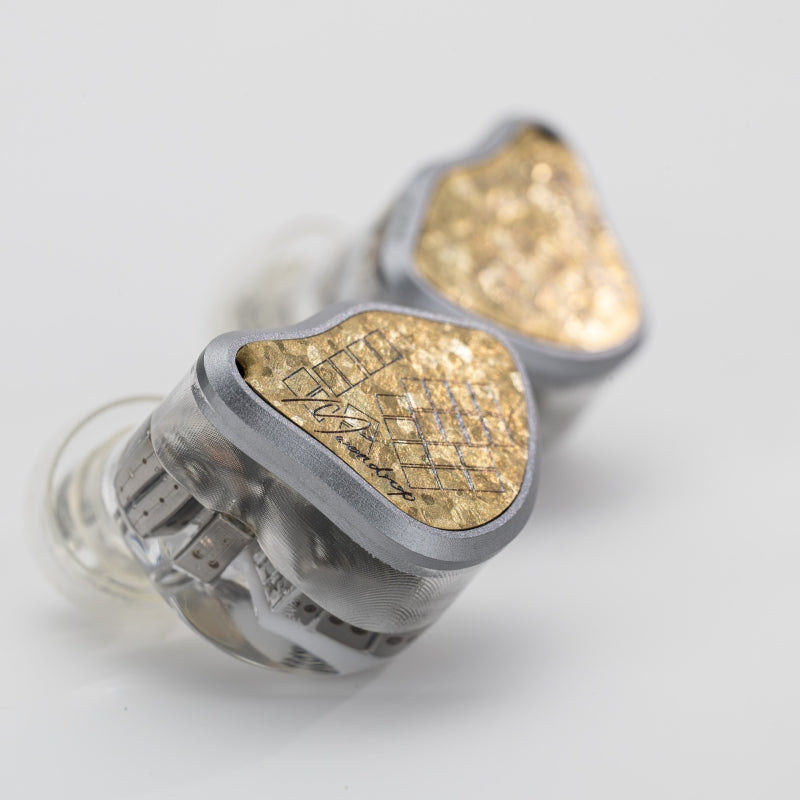
Here’s the thing — I respect this consistency. Exposing the internal engineering directly, unadorned, unmasked — this “engineering-first” mindset has real attitude in a market where more and more brands package their products as lifestyle accessories. The problem is: when you push this consistency onto the faceplate as a design statement, the visual result doesn’t live up to what the hardware is doing. A 24-BA flagship this ambitious deserves a more refined execution on the outside.
Why does this bother me? Because set aside the faceplate graphic, the hardware itself is genuinely strong. The highlight is the patented SUPERWOOFER module — 16 bass BAs arranged in eight groups along a progressive acoustic path (Chinese utility model patent ZL 2025 2 0166238.5), using time-delay design to enhance low-frequency dispersion. Mid-to-high frequencies are handled by four aluminium-magnesium alloy diaphragm BAs, with ultra-high frequencies covered by four additional custom BAs with damping suspension. This architecture is serious — this isn’t just shoving 24 identical BAs into a shell and calling it a flagship.
On the 3D printing side they’ve partnered with HeyGears — the industry’s best-known high-precision DLP printing solution — to ensure production consistency. The cable is a 19-core single-crystal copper + 19-core pure silver hybrid braid, with interchangeable plugs (3.5 mm / 4.4 mm). As a complete package, the engineering is flagship-grade.
| Drivers | 24 BA (16 low + 4 mid + 4 high) |
| Frequency Response | 7 Hz–35 kHz (effective 20 Hz–20 kHz, -3 dB) |
| Impedance | 5.8 Ω ±15% (@1 kHz) |
| Sensitivity | 119 dB/Vrms (@1 kHz) |
| THD | <0.7% (@1 kHz, 94 dB) |
| Connector | 0.78 mm 2-pin; interchangeable 3.5 mm / 4.4 mm plug |
| Cable | 19-core single-crystal copper + 19-core pure silver hybrid braid |
| Price | US$1,499 |
US$1,499. At this price point, an all-BA flagship is going up against brands like 64 Audio and Forte Ears — and those competitors operate at a different level of industrial design. The Armature Art 24’s hardware engineering has every right to stand in the same ring, and the engineering-to-design consistency is a design philosophy worth respecting. It’s just that when consistency comes at the cost of aesthetics, it’s worth asking — is there a way to preserve this internal-external correspondence while making it look like US$1,499?
If Moondrop had taken the same internal mapping and expressed it more subtly — etching, a fine dot matrix, or simply letting the transparent shell do the talking — honestly, the whole proposition would be far more convincing. Consistency doesn’t need to shout through graphics.
📌 Sources: Linsoul product page · Head-Fi official thread