
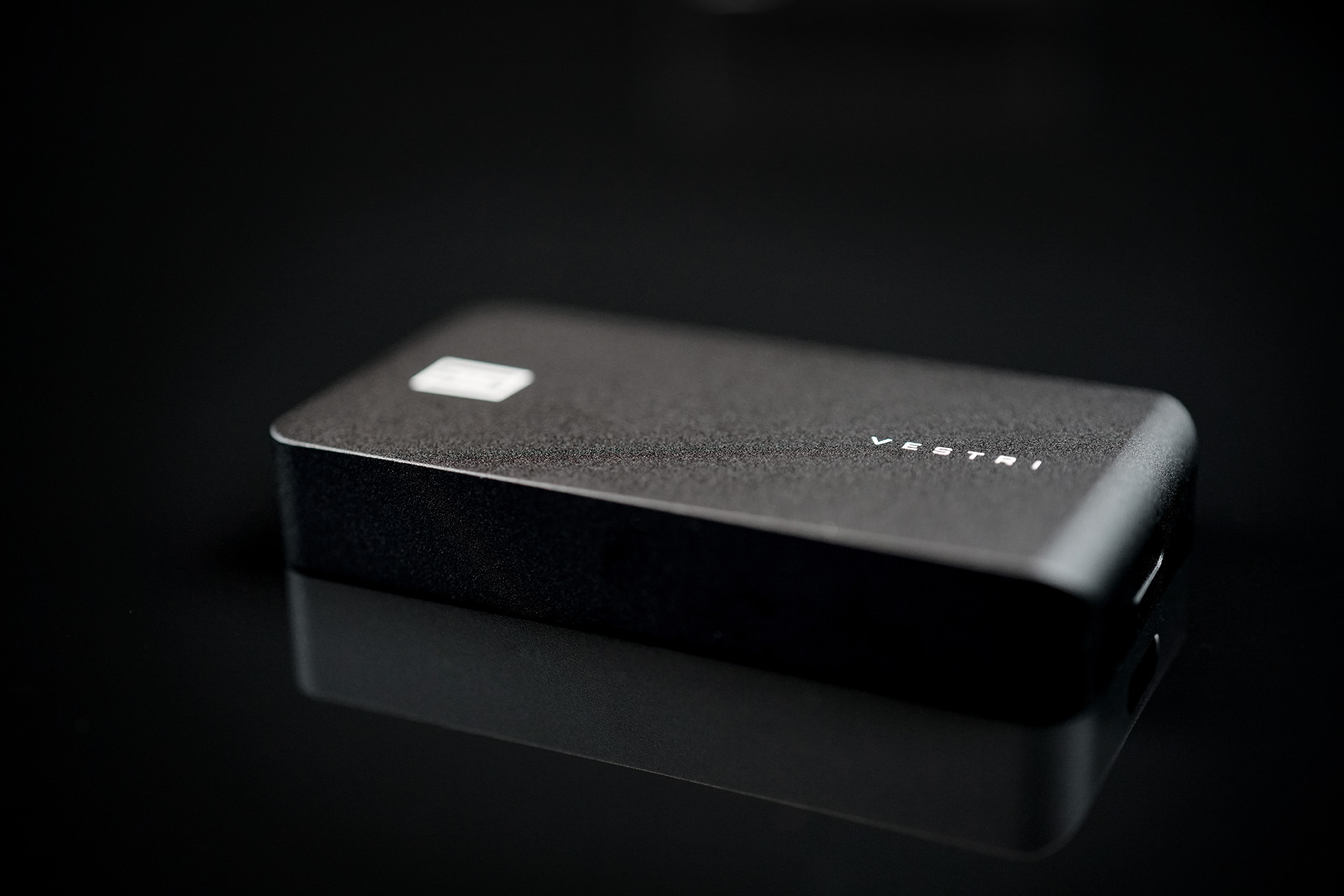
• Schiit’s first Mesh™ portable DAC/Amp — CNC’d aluminium alloy chassis + glass panel
• Capacitive touch controls, no physical buttons; LED matrix under glass for display — built to last, not to impress
• Unison USB™ + Mesh™ DAC (ES9018 + proprietary time-domain/frequency-domain optimized filter)
• 4.4mm balanced output up to 400mW @32Ω — drives the vast majority of headphones
• $99 USD — pre-order now, shipping May 28
• ⭐ Kaia’s take: “Schiit made the most Schiit portable DAC in the least Schiit way possible”
📑 Table of Contents
📝 Five Years in the Making: Schiit Finally Goes Portable
On May 15, 2026, Schiit Audio officially unveiled Vestri at CanJam Singapore — the company’s first truly portable DAC/headphone amp in its 16-year history. Priced at $99 USD, pre-orders are open now with shipping expected May 28.
For a brand so strongly identified with desktop-first design, this was a long time coming. Co-founder Jason Stoddard put it bluntly in the press release: “I’ve been joking that Vestri is the only dongle worth caring about — in a market of 10,000 products all using the same off-the-shelf solutions. That’s a cocky thing to say, but there’s some truth to it.”
Schiit’s product line has been almost entirely desktop for the past decade-plus: from the $49 SYS passive preamp to the $2,299 Yggdrasil flagship DAC — all plug-in-and-place-on-a-desk designs. Vestri marks the moment Schiit has finally squeezed its two core technologies — Unison USB™ and Mesh™ DAC — into a pocket-sized chassis.
🏭 Schiit Audio: Not Just a Name
Founded in 2010 by Jason Stoddard (ex-Sumo designer) and Mike Moffat (Theta Digital co-founder, early DAC pioneer), Schiit Audio is headquartered in Corpus Christi, Texas.
The company’s DNA rests on three pillars: (1) US-based vertical integration — design, PCB assembly, and final shipping all happen in their Texas facility; (2) Modular design — from Magni to Yggdrasil, most products accept DAC cards, Phono cards, and other upgrade modules; (3) No-BS philosophy — Schiit’s marketing is famously direct, humorous, and self-deprecating (the company name itself is a joke). Their positioning: “affordable high-end audio,” with zero tolerance for audiophile mysticism.
Vestri sits in Schiit’s “Fun” series alongside Buf ($99 recording interface) and Eitr 2 ($99 USB-to-SPDIF) — the most entry-level tier in Schiit’s lineup. But entry-level pricing doesn’t mean entry-level technology.
🔧 Design Breakdown: Why Vestri Is Different from Every Other Dongle
The portable DAC market is crowded — FiiO KA series, iBasso DC series, Questyle M series, ddHiFi, Hidizs, and more, each with their own angle. The mainstream recipe: pick a high-performance DAC chip, integrate a USB receiver, sometimes add a small screen and physical buttons, then wrap it all in a CNC aluminium shell. Schiit took a completely different path, inside and out.
🔩 Chassis: Aluminium + Glass, Zero Moving Parts
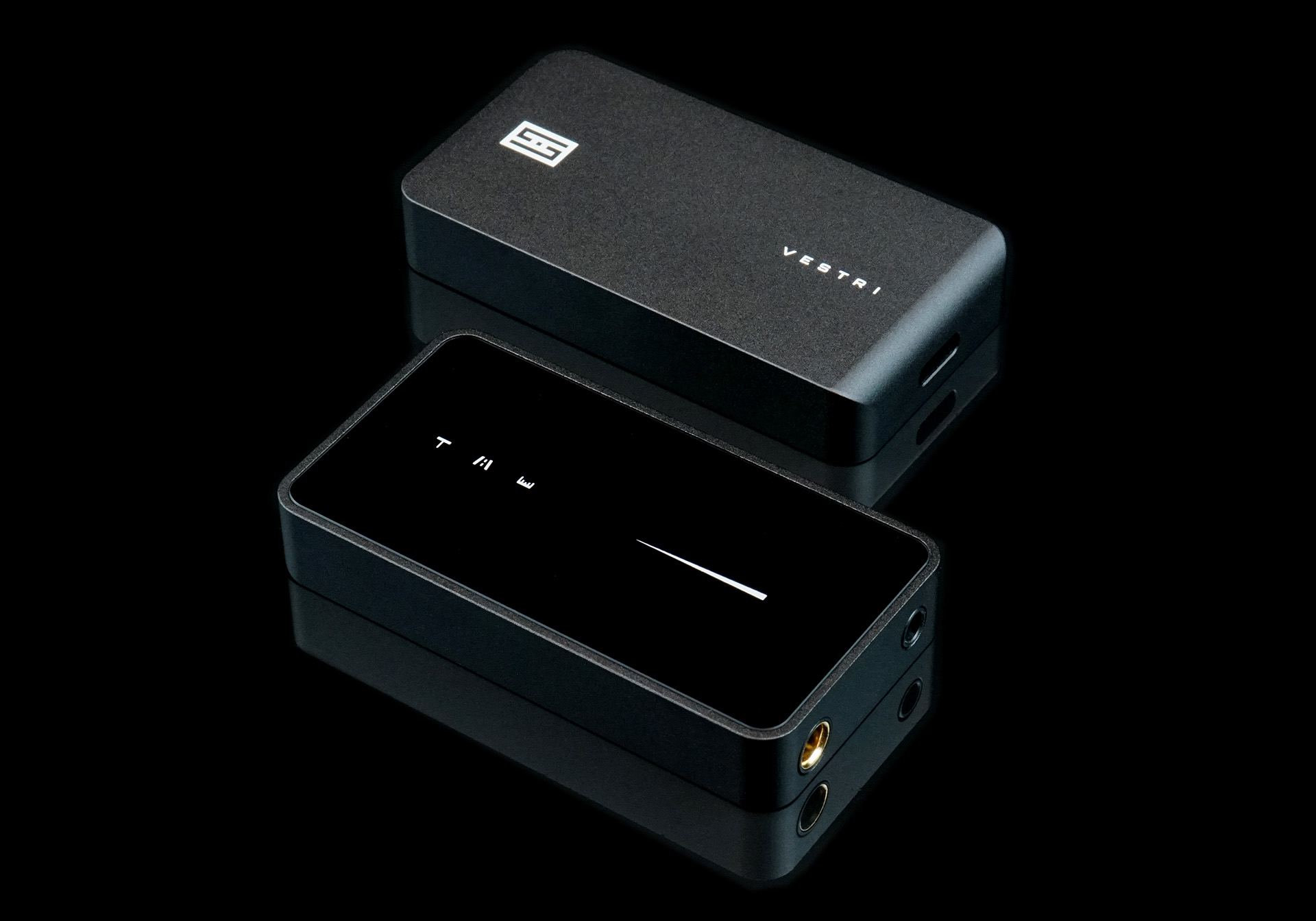
Vestri’s body is machined from a single block of aluminium alloy, topped with a glass panel. There are no physical buttons, no knobs, no switches anywhere on the chassis — everything is controlled via capacitive touch sensors beneath the glass. This design choice is fascinating: zero moving parts means zero mechanical wear, theoretically giving it a far longer service life than traditional designs. The trade-off? No “blind operation” — you’ll need to look at the device to hit the right touch zones.
💡 The “Eternal Screen”: A Counter-Trend Decision
Portable DACs typically handle displays one of two ways: most dongles have no screen at all, just a status LED or two; higher-end models add a small OLED for volume and sample rate info. Vestri takes a third route — a matrix of discrete lighting-style LEDs embedded under the glass, driven at extremely low current. Schiit calls it the “eternal screen,” claiming it will effectively never dim or burn in.
This design philosophy is pure Schiit. Jason Stoddard said in the press release: “OLED screens age — they’re consumables. We want to design for the next generation, not the next sale.” The LED matrix provides real-time status feedback (unlike no-display designs) with virtually unlimited lifespan (unlike OLED). On a $99 product, this choice reflects a value judgment: “How long do you want this thing to last?”
🎵 Mesh™ DAC: Schiit’s Secret Weapon
Mesh™ is Schiit’s most significant technical breakthrough in recent years. Traditional DAC chips (ESS, AKM, Burr-Brown) come with the manufacturer’s pre-loaded digital filters. Schiit has been using its own proprietary time-domain/frequency-domain optimized digital filters (what Mike Moffat calls the “megacomboburrito”) since Bifrost, but these previously required expensive Analog Devices DSP chips to run.
Mesh™’s breakthrough: porting that proprietary filter algorithm onto the Unison USB’s 32-bit Microchip processor, paired with a standard delta-sigma modulator (Vestri uses the ESS ES9018). This delivers Schiit’s signature sound at $99 without adding a separate DSP chip.
Notably, Vestri also offers NOS (Non-Oversampling) mode — bypassing all internal filters for users who want to do their own DSP in software (HQPlayer, etc.) and feed raw PCM straight to the DAC. This feature is virtually unheard of at $99.
🔊 Output Stage: TI OPA1656 × 2 — Plenty of Power for Most Headphones
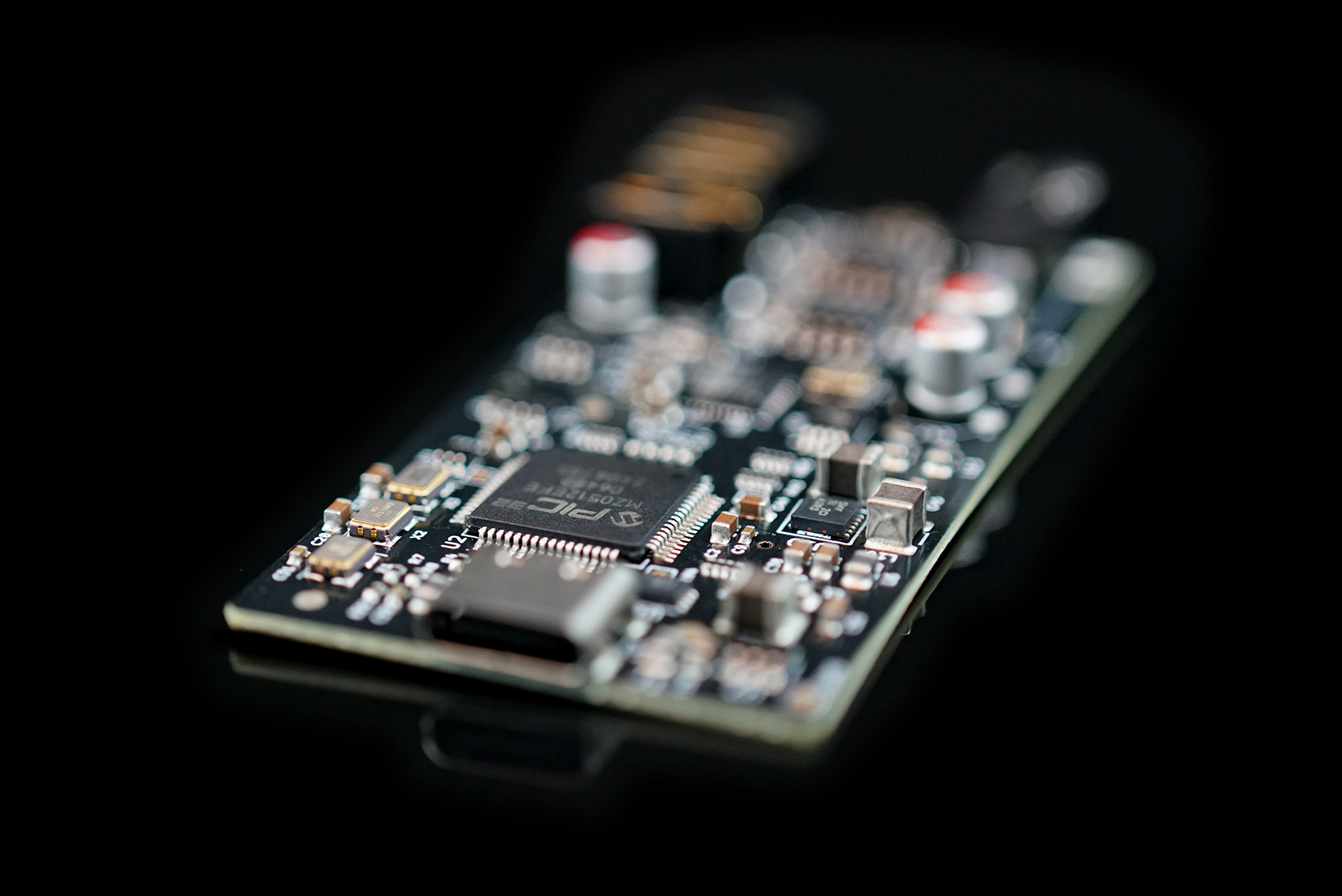
Vestri uses two TI OPA1656 op-amps for the analog output stage. 4.4mm balanced delivers up to 400mW @32Ω, 3.5mm single-ended up to 200mW @32Ω. That’s upper-midrange for this price tier — enough to drive virtually all IEMs and high-efficiency over-ears (Sennheiser HD 600/660S, Beyerdynamic DT series), though ultra-low-sensitivity planars (like Hifiman Susvara) will be beyond its reach.
Power comes entirely from USB. Internal bi-polar switching regulators generate ±5V rails, filtered through inductors and local regulation. Typical draw is just 0.9W — hardly any battery drain on a phone.
🎛️ Touch Controls: Loudness, Invert, NOS — All Onboard
Beyond volume, Vestri’s touch interface offers three utility toggles: Loudness (bass compensation at low volumes), Invert (phase inversion for correcting certain recordings), and NOS mode. Compared to competing dongles that typically offer only volume and gain switching, this feature set is generous.
💡 Kaia’s Take: Designer Trade-offs
Schiit’s approach to building Vestri is fundamentally different from the mainstream dongle market. Most brands chase the latest DAC chips, add screens, add buttons, pile on spec numbers. Schiit went the other way — using a “dated” ES9018, ignoring display spec sheets, and pouring all their energy into their proprietary filter algorithms and build durability.
This trade-off reveals Schiit’s different definition of “what makes a good product.” They don’t care about spec sheet competition (though Vestri’s measurements are excellent). They care about whether “this thing will still work five years from now.” The ETERNAL SCREEN is the perfect example — the LED matrix philosophy is “good enough to see, most importantly it won’t break.” In a market of feature competition, that kind of restraint is itself a statement.
But let’s be clear: touch controls on a display-less device takes getting used to. USB power limits total output headroom. No battery means you’re tethered to your phone. These aren’t flaws — they’re trade-offs. The question is whether you can live with them.
📋 Technical Specifications
| Frequency Response | 20Hz–20kHz, ±0.05dB |
| THD | <0.0002%, 20Hz–20kHz, @3V RMS SE / 6V RMS BAL |
| IMD | <0.0003%, CCIR |
| SNR | >118dB, A-weighted, ref 2V RMS |
| Crosstalk | >−80dB, 20Hz–20kHz |
| Output Impedance | <0.5Ω |
| Balanced Output Power | 400mW @32Ω / 320mW @50Ω / 120mW @300Ω |
| Single-Ended Output Power | 200mW @32Ω / 150mW @50Ω / 40mW @300Ω |
| USB Receiver | Schiit Unison USB™ (up to 32-bit/192kHz) |
| D/A Conversion | Schiit Mesh™ (proprietary digital filter + ESS ES9018 modulator) |
| Analog Output Stage | TI OPA1656 × 2 |
| Output Jacks | 4.4mm balanced + 3.5mm single-ended |
| Features | Loudness / Invert / NOS mode (touch toggle) |
| Power Consumption | 0.9W (typical) |
| Dimensions | 61 × 36 × 11mm (2.4 × 1.4 × 0.44″) |
| Weight | 113g (4 oz) |
| Warranty | 2-year limited (US factory) |
| Price | $99 USD |
| Ship Date | May 28, 2026 (pre-order now) |
📊 Data source: Schiit official APx test report|Manufacturer-published figures
✅❌ Design Trade-offs: Pros & Cons
| ✅ Pros | ❌ Limitations |
|---|---|
| • Full CNC aluminium + glass chassis — build quality far above its price class | • Touch controls without display feedback — learning curve on first use |
| • Mesh™ + Unison USB™ tech combo — authentic Schiit sound DNA | • USB power limits total output — not enough for extremely demanding headphones |
| • Excellent measured performance (THD <0.0002%, SNR >118dB) | • No battery — must be connected to a USB source to operate |
| • NOS mode for HQPlayer/software DSP pipeline | • Lightning iPhone users need to watch power constraints |
| • LED matrix display — theoretically infinite lifespan, no burn-in risk | • No official distribution outside US — must order directly from Schiit |
| • Made in Schiit’s Texas factory — not OEM/ODM | • $99 + international shipping |
🏁 Market Positioning
$99 USD puts Vestri in an interesting spot in the portable DAC market. It’s slightly cheaper than the FiiO KA17 (~$110) and iBasso DC07 (~$100), a bit pricier than the ddHiFi TC44C (~$60). Given Vestri’s full aluminium chassis, Mesh™ DAC, and US manufacturing, that pricing is aggressive.
Vestri competes not on specs or features but on a fundamentally different philosophy: build it like a tank, make the sound right, and don’t worry about next year’s chip. Whether that resonates with buyers at $99 will be the real test.
🎯 Who Is It For?
| 👍 For You If… | 👎 Not For You If… |
|---|---|
| • You want to experience Schiit’s house sound without buying a desktop rig | • You need blind operation (e.g., pocket use while commuting) |
| • You value build durability over feature quantity | • You’re on Lightning iPhone and don’t want an adapter |
| • You’re into HQPlayer / custom DSP workflows | • You mainly listen to ultra-demanding planar magnetic headphones |
| • “Made in USA” matters to you | • You need Bluetooth + USB dual-mode |
🏁 Summary
Vestri is the portable DAC Schiit built for itself — not to chase market trends, but because they finally found a way to do it on their own terms. Mesh™ filter + Unison USB + aluminium/glass chassis + eternal screen: there’s nothing quite like this combination at $99. Not because it out-specs everything, but because nobody else builds a portable DAC with this logic.
The downsides are real: no display, no battery, touch controls take practice. But behind every one of those limitations is the same design decision: “We want to build something that still works a decade from now.” That priority is almost alien in consumer electronics in 2026.
Bottom line: Vestri may not be the most convenient portable DAC — but it’s quite possibly the longest-lasting one.
❓ FAQ
🔹 Does Vestri work with Lightning iPhones?
Vestri uses USB-C input. Lightning iPhones require a Lightning to USB-C OTG adapter (such as Apple’s Lightning to USB Camera Adapter). Be aware that Lightning’s power output is limited (~200mW max), which may restrict balanced output power. iPhone 15 and later USB-C models work directly with no limitations.
🔹 Where can I buy the Schiit Vestri?
Schiit currently has no official distributors outside the US. You’ll need to order directly from the Schiit website. International shipping runs approximately $20–40 USD depending on the method. Note that the $99 price does not include shipping or potential customs duties.
🔹 How is Vestri different from other ~$100 DACs like the FiiO KA17 or iBasso DC07?
The biggest difference is design philosophy. The KA17 and DC07 pursue feature richness (screens, buttons, multi-level gain) with the latest DAC chips. Vestri goes the opposite direction — a “dated” ES9018 + proprietary Mesh™ filter, with cost invested in the CNC’d aluminium chassis and US manufacturing. The result: Vestri’s build quality and longevity far exceed its price class, but features are more minimalist. Which one suits you depends on whether you prioritize “features” or “build quality + longevity.”
🔹 What is NOS mode and what’s it for?
NOS (Non-Oversampling) mode bypasses the DAC chip’s internal digital filter, sending raw PCM data directly to the conversion stage. The practical use is pairing with HQPlayer, Roon, foobar2000, etc. to perform high-quality DSP upsampling/filtering on the computer side, then feeding it straight to Vestri. NOS mode at $99 is extremely rare.
🔹 Can Vestri drive Sennheiser HD 600 / HD 660S?
At 400mW @32Ω balanced, Vestri can drive HD 600 (300Ω, 97dB/mW) to adequate volume, but not with abundant headroom. Single-ended 200mW will struggle noticeably. If HD 600/660S are your primary headphones, use a balanced cable with the 4.4mm output — volume headroom improves significantly. HD 660S (150Ω) is easier to drive than HD 600. DT 770/990 (250Ω) are also manageable on the balanced output.
📖 Related Reading
🔗 More Information
🛒 Product page: Schiit Audio — Vestri
📰 Official press release: Vestri? I Hardly Knew Ye! (2026/5/15)
📊 APx measurement report: Schiit APx Test Suite — Vestri (PDF)
📖 User manual: Vestri Manual (PDF)
💰 $99 USD