
📌 The One-Minute Verdict
• Semi-open dual-dynamic — vocals shine, but the mid-bass is lean and layering is the biggest weakness
• Called “FORCE” but bass impact and extension both score just 2/5
• Effect Audio cable + excellent comfort (4/5) boost the package
• Vocal-driven tracks (tuki., J-pop female) sound surprisingly clear; bassheads need not apply
• 💰 MSRP: HK$1,299 | ⭐ Overall: 2.8/5 | ❄️ Cool-leaning
📋 Specifications
| Product | TANCHJIM FORCE × EFFECT AUDIO |
| Type | Semi-Open Dual-Dynamic In-Ear Monitor |
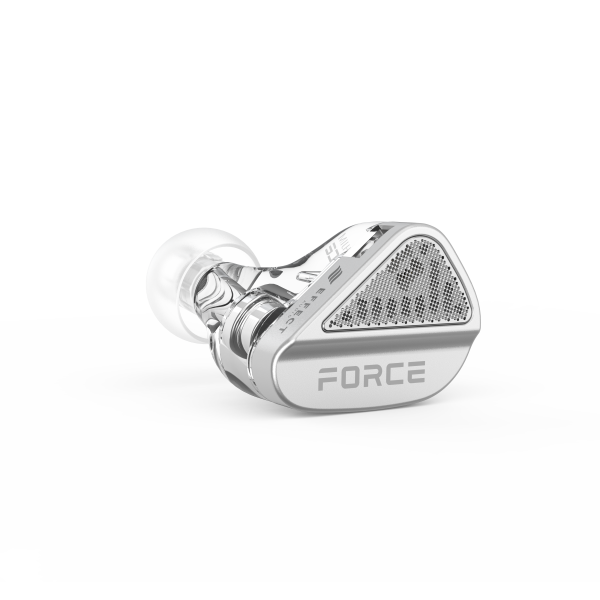
| Driver Configuration | 8.2mm Beryllium DD + 10mm Titanium DD (DMT4 Ultra Dual-Composite Metal-Plated Dome) |
| Frequency Response | 10Hz – 40kHz |
| Impedance | 16Ω ±15% |
| Sensitivity | 110dB SPL/mW @1kHz |
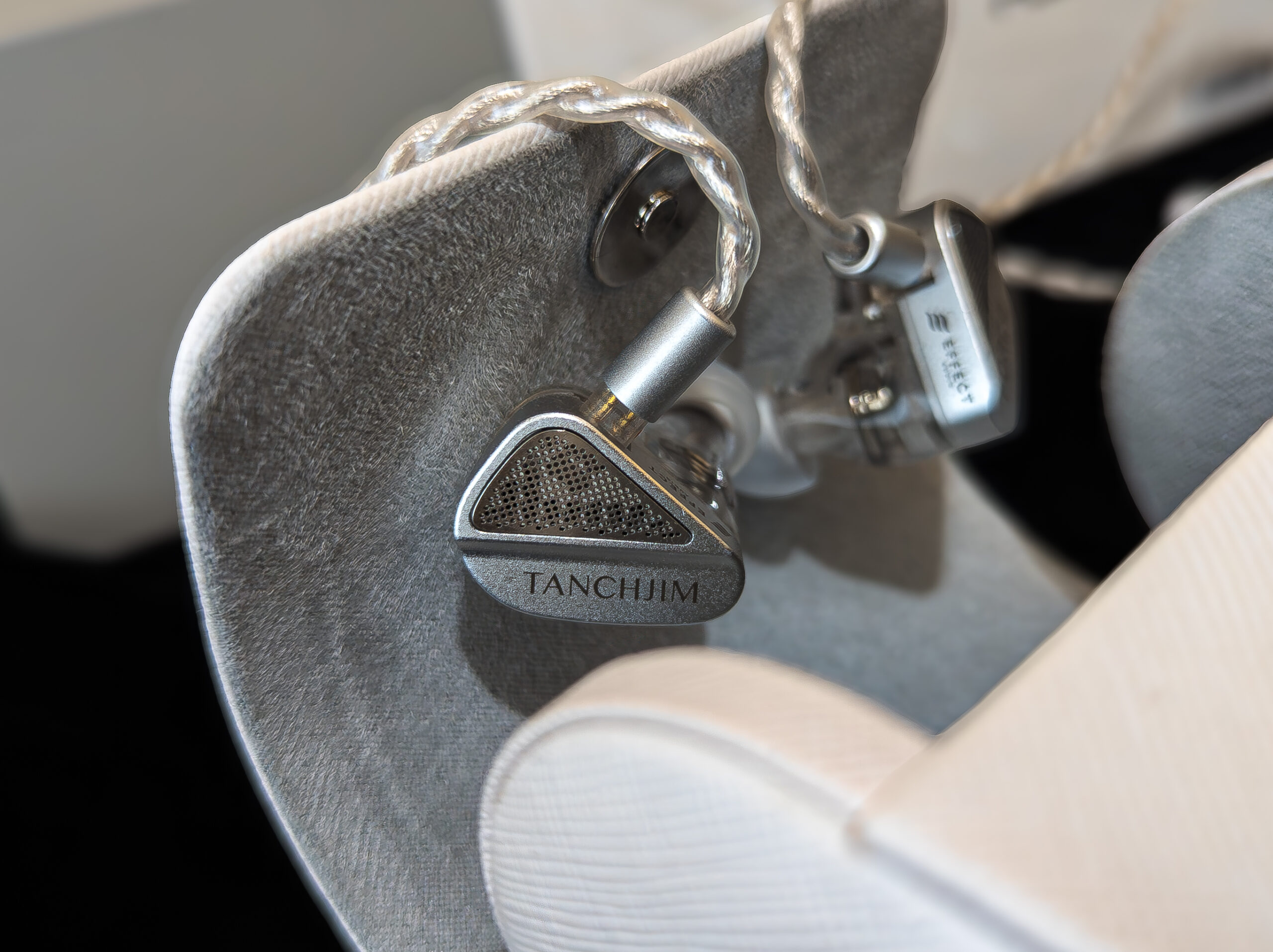
| Cable | EFFECT AUDIO 4-Strand UP-OCC Silver-Plated Single-Crystal Copper (26AWG), 0.78mm 4-pin Detachable |
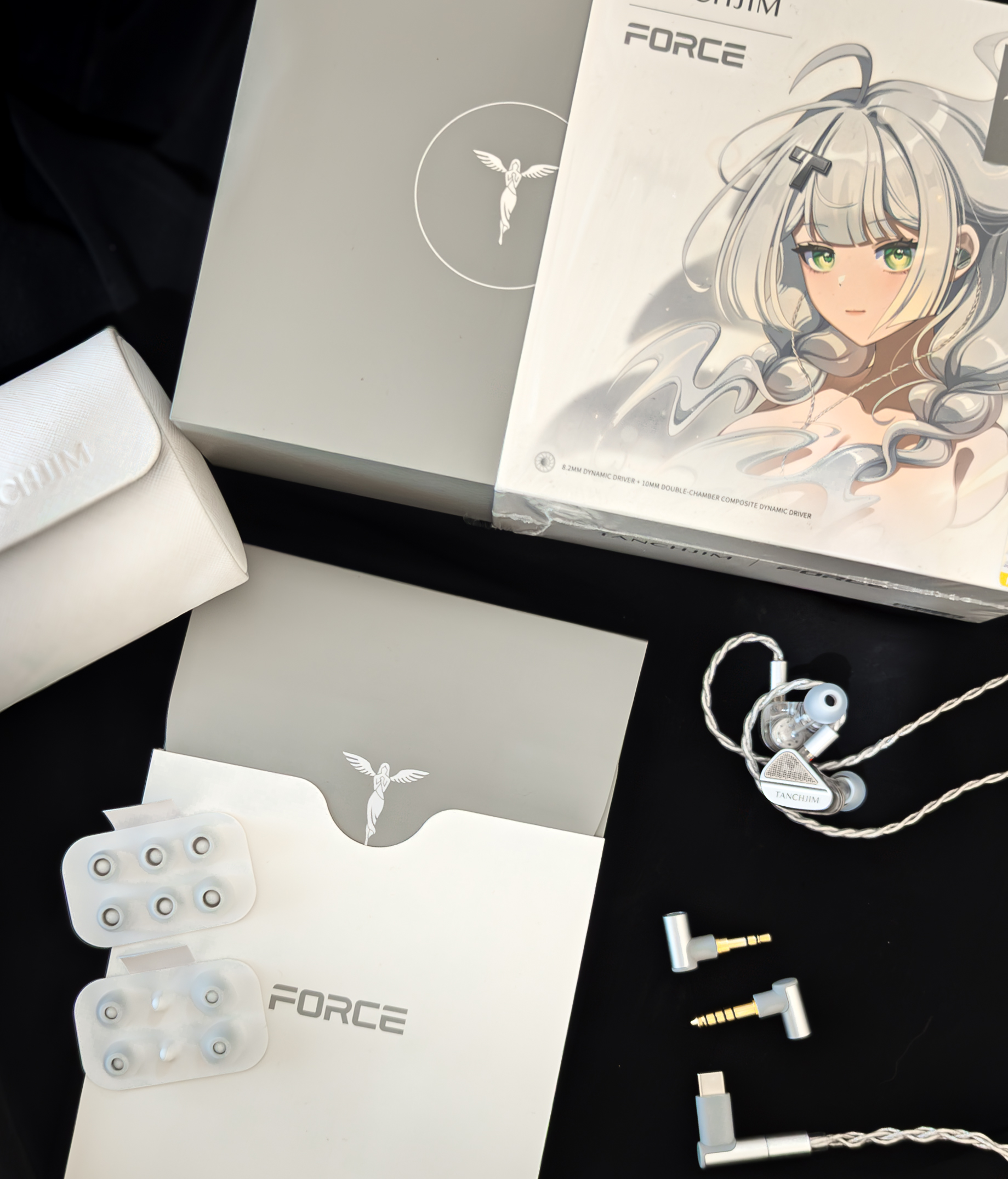
| Connector | 3.5mm Single-Ended / 4.4mm Balanced / DSP Type-C (All Three Plugs Included) |
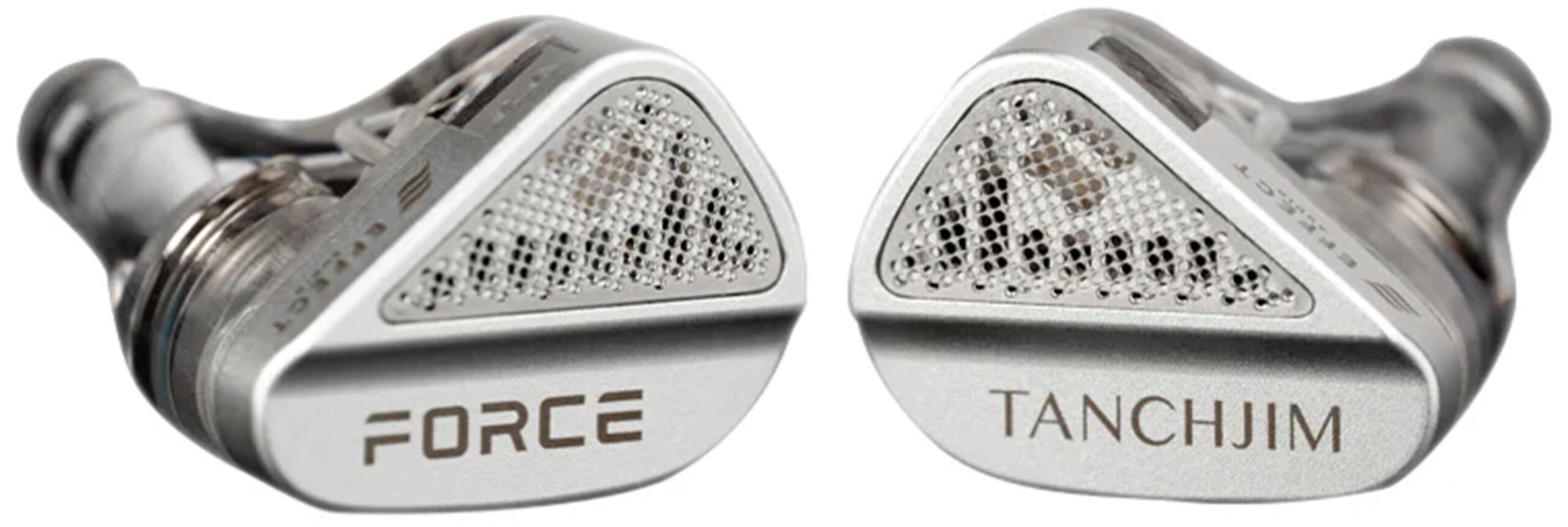
| Shell Material | Medical-Grade 3D-Printed Transparent Resin + CNC Aluminium Faceplate |
| Accessories | Silicone Ear Tips ×6 (2 Types, S/M/L), Carry Case, Cleaning Tool |
| Price | HK$1,299 |
🔊 Kaia’s Take
The TANCHJIM FORCE is an honest IEM — it doesn’t hide its semi-open nature, nor does it use tuning filters to fake a “versatile” sound. That honesty is refreshing, but the market reality is this: most listeners expect a product called “FORCE” to deliver force — and in the bass department, it simply doesn’t. The semi-open design brings genuine benefits in soundstage openness and wearing comfort, but the trade-off is bass energy leakage. This is an engineering choice, not a design flaw.
From a product design perspective, the 8.2mm beryllium + 10mm titanium dual-driver setup is theoretically capable of much deeper bass — the bottleneck is the semi-open acoustic chamber. The semi-open back vents through a stainless steel mesh that TANCHJIM claims “enhances soundstage naturalness and bass transient response.” In practice, it enhances soundstage at the expense of bass body — a fair trade, but one that undermines the “FORCE” branding.
The Effect Audio collaboration cable is a smart move — it elevates perceived value and brings genuine texture improvements to the mid-to-high frequencies. But it’s also a double-edged sword: at HK$1,299, a significant chunk of the cost is in the cable, which puts the IEM’s own acoustic performance under more scrutiny. Would reallocating some of that cable budget into acoustic tuning yield a better overall package? That’s an open question — and one worth asking for a product named after power.
| 🎵 Sound | ⭐⭐☆☆☆ 2.5/5 |
| 👂 Comfort | ⭐⭐⭐⭐☆ 4/5 |
| 🔧 Build Quality | ⭐⭐⭐⭐☆ 4/5 |
| 💰 Value | ⭐⭐⭐⭐☆ 4/5 |
| ✨ Design | ⭐⭐⭐⭐☆ 4/5 |
| 🎧 Daily Use | ⭐⭐⭐☆☆ 3/5 |
| ⭐ Overall | 2.8 / 5 | ❄️ Sound Signature: Cool-Leaning |
🎧 Introduction
TANCHJIM has carved out a reputation as the “design house” of Chinese audio — known for metal shell craftsmanship and refined tuning. From the Oxygen to the PRISM, the brand has built a sonic philosophy of clarity, transparency, and understatement. The FORCE marks TANCHJIM’s first collaboration with Singaporean cable powerhouse Effect Audio — a semi-open dual-dynamic IEM (8.2mm beryllium + 10mm titanium diaphragm drivers) priced at HK$1,299, stepping directly into the fiercely competitive sub-$200 bracket.
TANCHJIM named this dual-dynamic IEM “FORCE” — clearly signalling ambition in bass dynamics and control. The 8.2mm beryllium DD handles mids and highs while the 10mm titanium DD takes bass duties, with the DMT4 Ultra dual-composite dome structure theoretically enabling precise frequency division. The semi-open rear chamber features a stainless steel vent mesh that TANCHJIM claims reduces bass bloat and widens the soundstage — a bold promise from a product named after power.
But in practice, this semi-open design proves to be a double-edged sword. It brings a welcome touch of airiness and keeps bass decay fast and clean — yet simultaneously leaves the overall signature feeling thin. The Effect Audio collaboration cable uses UP-OCC silver-plated single-crystal copper with excellent 4-strand braiding, and the triple-plug system (3.5mm / 4.4mm / DSP Type-C) is included in the box. On paper, this is a genuinely generous package. But an IEM ultimately lives or dies by its sound — and that’s where things get complicated.
📊 Frequency Range Analysis
🔻 Bass: Fast but Undernourished
| Extension | ⭐⭐☆☆☆ 2/5 |
| Body | ⭐⭐☆☆☆ 2/5 |
| Speed | ⭐⭐⭐☆☆ 3/5 |
| Impact | ⭐⭐☆☆☆ 2/5 |
| Control | ⭐⭐⭐☆☆ 3/5 |
The FORCE’s bass is a clear weakness — and it’s the Achilles’ heel of the entire semi-open design philosophy. Extension lacks depth, and drum hits land without that satisfying physical thump (extension 2/5, impact 2/5). Body is thin, and overall bass presence feels undernourished (body 2/5). The upside is speed: decay is quick and clean without muddiness (speed 3/5, control 3/5). The semi-open design prevents bass bloat, but the trade-off is a “disciplined but underpowered” listening experience. If you enjoy electronic drum patterns or hip-hop bass drops, the FORCE’s low-end will leave you thinking “fast enough — but not nearly enough.”
◾ Midrange: Vocal-Forward but Structurally Lean
| Vocals | ⭐⭐⭐☆☆ 3/5 |
| Detail Retrieval | ⭐⭐☆☆☆ 2/5 |
| Fullness | ⭐⭐☆☆☆ 2/5 |
| Layering | ⭐⭐☆☆☆ 2/5 |
| Cohesion | ⭐⭐☆☆☆ 2/5 |
The midrange is FORCE’s most conflicted region. Vocals are relatively forward (3/5), and this is immediately apparent on tuki.’s “Love expiration date” — the vocal clarity and forward placement are genuinely engaging. If bass isn’t your priority, the vocal presentation here is the FORCE’s strongest card.
But the midrange skeleton is noticeably lean: detail retrieval (2/5) means micro-texture is lacking, fullness (2/5) leaves vocals sounding “clear but hollow,” layering (2/5) means instrument separation isn’t sharp enough in complex arrangements, and cohesion (2/5) indicates vocal imaging is diffuse. The result? The vocal steps forward, but the entire midrange lacks depth — like a photo with a sharp foreground and a blurry background. On mature male vocals (think Hideaki Tokunaga or Koji Tamaki), voices sound like they’ve dropped a size — the lower midrange warmth that gives male vocals their weight is conspicuously absent.
🔺 Treble: Bright but Lacking Texture
| Extension | ⭐⭐⭐☆☆ 3/5 |
| Brightness | ⭐⭐⭐⭐☆ 4/5 |
| Refinement | ⭐⭐☆☆☆ 2/5 |
| Transient Response | ⭐⭐⭐☆☆ 3/5 |
| Airiness | ⭐⭐⭐☆☆ 3/5 |
The treble is FORCE’s relative strong suit. Brightness reaches 4/5 — strings and brass have a distinct sense of sheen that can be genuinely exciting on the right tracks. But extension is only 3/5; the upper treble doesn’t stretch naturally and starts to strain.
The biggest experience-killer is refinement at just 2/5 — the treble has brightness but carries noticeable grain, lacking the smoothness needed for fatigue-free long sessions. Transient response (3/5) is average; airiness (3/5) benefits from the semi-open design’s subtle ventilation — the treble never feels fully boxed in, but it doesn’t approach the transparent layering of a true open-back. Compared to the Truthear ZERO (neutral-bright) or Kiwi Ears Cadenza (warm) at similar prices, the FORCE’s treble is the most distinctive — but whether that distinctiveness is a strength depends entirely on your source pairing and music preferences.
🔧 Other Ratings
| 👂 Comfort | ⭐⭐⭐⭐☆ 4/5 — Medical-grade 3D-printed resin shells conform well to the ear; low fatigue even during long sessions |
| 🔇 Isolation | ⭐⭐☆☆☆ 2/5 — Semi-open design has weak isolation; requires a quiet listening environment |
| 🔧 Build Quality | ⭐⭐⭐⭐☆ 4/5 — CNC aluminium faceplate + transparent resin shell + EA cable — named “FORCE” but built with integrity |
| 🎼 Sound Signature | ❄️ Cool-Leaning — Treble is bright but mid-bass is lean; overall analytical-leaning |
| 🎧 Soundstage | ⭐⭐☆☆☆ 2/5 — Semi-open design brings some airiness but falls short of a true open-back soundstage; layering and separation are insufficient |
| ⚖️ Tonal Balance | ⭐⭐☆☆☆ 2/5 — Frequency distribution is uneven; lower mids are noticeably thin, vocals are forward but the overall skeleton lacks body |
| 🎯 Brand Trust | ⭐⭐⭐☆☆ 3/5 — TANCHJIM sits in the mid-tier; the Effect Audio collaboration adds a welcome layer of craft confidence |
✅❌ Pros & Cons
| ✅ Pros | ❌ Cons |
|---|---|
| • Effect Audio collaboration cable is superbly built — outstanding 4-strand braiding with retail value near half the IEM’s price | • Bass extension and body both score 2/5 — the “Force” name sets expectations the bass can’t back up |
| • Triple-plug system included: 3.5mm / 4.4mm / DSP Type-C — all three covered in the box | • Midrange layering and cohesion both 2/5 — instrument separation falls short in dense arrangements |
| • Excellent comfort — medical-grade resin shells conform naturally to the ear for all-day wear | • Treble refinement 2/5 — bright but noticeably grainy, causing fatigue over long sessions |
| • Forward, prominent vocals with surprising clarity on vocal-driven tracks | • Semi-open design has weak isolation — a quiet listening environment is essential |
| • Fast, clean bass decay without muddiness — decent control for a semi-open design | • Soundstage is narrow — the semi-open design creates an “illusion” of openness rather than genuine air |
🔌 Pairing Recommendations
| 🎧 Ear Tips | Soft-bore ear tips — increase lower-mid body and seal to compensate for semi-open bass leakage. Recommended: SpinFit CP100+ or Final Type E. |
| 📱 Source | Warm DAP — neutralises the cool-leaning signature for a more balanced presentation. Recommended: iBasso DX180, Shanling M5 Ultra, or FiiO M23. |
| 🎵 Music | Vocal-driven pop, J-pop female vocals, acoustic — avoid bass-heavy electronic and drum-dense tracks. The FORCE is a specialist, not an all-rounder. |
🎯 Who Is It For?
| 👍 Ideal For | 👎 Not For |
|---|---|
| • Vocal-forward listeners — J-pop female vocals, acoustic, jazz vocal. If 80%+ of your library is vocal-driven, the FORCE earns its keep. | • Bassheads — if you want that rumbling, visceral sub-bass, the FORCE will disappoint. Look at the Truthear ZERO or 7Hz Legato instead. |
| • Build quality and accessory enthusiasts — the EA cable + triple-plug system is excellent value for the package. | • Commuters — weak isolation means listening quality tanks in noisy environments like the MTR or bus. |
| • Listeners who enjoy the airy feel of semi-open designs for quiet, focused listening sessions. | • Audiophiles seeking soundstage width and layering — better options exist at this price for spatial presentation. |
🏁 Verdict
The TANCHJIM FORCE × Effect Audio collaboration delivers impressively on hardware and accessories — DMT4 Ultra dual-drivers, triple-plug system included, EA cable — at HK$1,299 this is genuinely strong value for what’s in the box. But sonically, the FORCE’s semi-open design trades fullness for airiness — the lean bass and midrange make it hard to get truly immersed. Vocals are clear but the skeleton is lean; treble has brightness but lacks refinement. The overall listening experience leans more analytical than enjoyable.
If you primarily listen to vocal-driven music — J-pop female vocals, acoustic, jazz — pairing with soft-bore ear tips and a warm source lets the FORCE play to its strengths beautifully. But if you want a versatile, balanced all-rounder, there are more compelling options at this price point.
The FORCE’s “force” isn’t in thunderous bass — it’s in the genuine commitment of the Effect Audio cable collaboration and the honesty of a tuning that doesn’t try to please everyone. But an IEM ultimately needs to deliver sonically, and while the FORCE is an admirable specialist, its narrow focus means it’s not for everyone. The TANCHJIM FORCE is an IEM you need to understand before you can love — not the kind that makes you go “wow” on first listen.
❓ FAQ
🔹 What music genres suit the TANCHJIM FORCE?
The FORCE excels with vocal-driven genres — J-pop female vocals (Aimer, milet, YOASOBI), acoustic pop, jazz vocal, and string quartet all play to its strengths. The cool-leaning signature and lean bass mean EDM, hip-hop, and metal are less suited. Its semi-open, mid-forward presentation is tuned for intimacy and clarity, not impact.
🔹 Does the FORCE come with tuning filters?
No — the FORCE does not include tuning filters or interchangeable nozzles. TANCHJIM chose a fixed acoustic design with the semi-open chamber and EA cable as the primary tuning elements. This means what you hear is what you get — the sound signature is baked in and can’t be altered with filter swaps.
🔹 Where can I audition and buy the FORCE in Hong Kong?
The FORCE is available through TANCHJIM’s authorised Hong Kong retailers. We strongly recommend an in-store audition first — the FORCE has a distinctive cool-leaning signature that won’t suit everyone. Make sure it matches your preferences before committing.
🔹 How does the FORCE compare to competitors at this price?
At HK$1,299 (~US$165), the FORCE competes with the Truthear ZERO, Kiwi Ears Cadenza, and 7Hz Salnotes Zero. Where it wins: build quality (CNC aluminium + medical-grade resin), the EA collaboration cable, and vocal-forward midrange. Where it falls short: bass quantity (leaner than all three competitors), treble refinement, and overall versatility. The FORCE is the most “specialist” of the bunch — brilliant for vocals, less so for everything else.
🔹 Is the cable detachable? What connector does it use?
Yes, the FORCE uses a 0.78mm 4-pin connector (not the more common 2-pin). While the included Effect Audio cable is excellent, if you want to explore other 4-pin aftermarket cable options, compatibility is more limited than standard 2-pin IEMs. Double-check your existing cable collection before buying.
🔗 More Info
- Product Page: TANCHJIM FORCE × EFFECT AUDIO
- Head-Fi Discussion: TANCHJIM FORCE Thread